The Role of the AO Token
The AO token is the native cryptocurrency of the AO decentralized supercomputing network and serves as the principal mechanism that powers the network’s hyper-parallel computation environment. It enables staking, slashing, economic validation of computational outcomes, and the operation of AO’s security markets. Through AO, users, developers, and asset providers participate in the network’s economic growth while securing and verifying decentralized computation.
AO is built as a compute layer on top of Arweave’s permanent data storage system. While Arweave preserves information, AO performs computation. The AO token ties these functionalities together by providing the economic security necessary to verify interactions between processes and also fuels liquidity and application development across the ecosystem.
Why Is the AO Token Important?
Participation in the AO network, whether through securing message execution, staking to provide economic guarantees, or contributing bridged yield-bearing assets, relies on AO tokens. The network’s central economic-security system, AO-Sec Origin, uses AO to cryptographically and economically back proofs of computational results, offering a flexible variation of Proof of Stake tailored to AO’s architecture.
Users can select the security level for each message they send and pay for verification guarantees according to need. This creates an economically efficient security marketplace where AO functions as the stake behind trusted computation. AO also incentivizes network expansion. Bridging yield-bearing assets such as stETH generates AO tokens for participants, and AR holders continue to receive token mints for securing Arweave, promoting a continuous flow of economic value and aligning incentives across the ecosystem.
Token Supply and Distribution
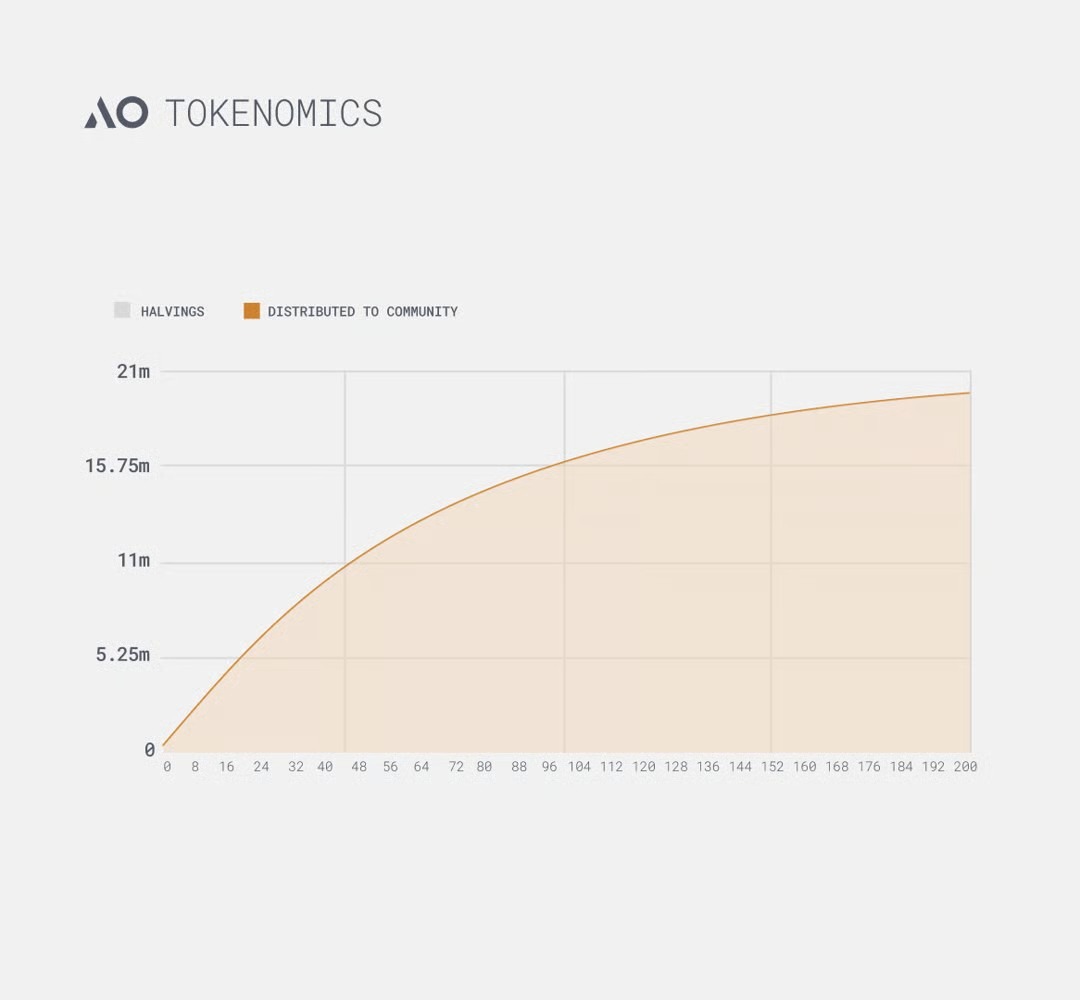
AO uses a capped supply model similar to Bitcoin, with a maximum of 21 million tokens. New AO is minted every five minutes, and the emission rate gradually decreases by 1.425 percent of the remaining supply per month rather than through abrupt halving events.
AO distribution occurs entirely through community-based minting.
Minting to AR Holders (approximately 36 percent of supply): AR holders receive AO tokens proportional to their balances. The first retroactive distribution covered the period from February 27 to June 18, 2024. After June 18, one-third of all new AO continues to go to AR holders indefinitely, securing Arweave as AO’s foundational layer.
Minting for Bridged Assets (approximately 64 percent of supply): The remaining two-thirds reward users contributing yield-bearing assets such as DAI, USDS, and stETH. Rewards accrue daily relative to each participant’s share of bridged assets, and future phases will introduce derivative tokens such as aoETH for use within AO.
Managing and Storing AO Tokens
AO tokens are distributed to Arweave wallets, which serve as identities within the AO network. AR holders must delegate their AR balances in order to accrue AO, which is then credited to their Arweave wallets. Bridgers specify the destination addresses for minted tokens when depositing assets. Users holding AR on centralized exchanges must coordinate with the exchange to ensure their tokens are properly delegated and claimable.
How to Acquire AO Tokens
Holding AR Tokens: Users can delegate their yield-bearing AR balances to accrue AO directly in their Wander wallets. Delegation may be performed either within the Wander interface or on the dedicated AO delegation page. AO is automatically minted based on the user’s delegated AR holdings and credited to the corresponding Arweave wallet every five minutes.
Bridging Yield-Bearing Assets: Users deposit assets such as DAI, USDS and stETH and receive AO mints proportional to contributions. Deposits remain on their native chain and can be withdrawn without penalty.
In Conclusion
The AO token forms the foundation of a decentralized compute economy. It enables staking, verification, and flexible security markets while incentivizing liquidity inflow via bridged assets. AO’s community-driven, predictable tokenomics create a sustainable framework for verifiable, scalable computation, aligning incentives across storage, computation, and liquidity, and supporting a robust ecosystem for decentralized applications and autonomous computational processes.